Search
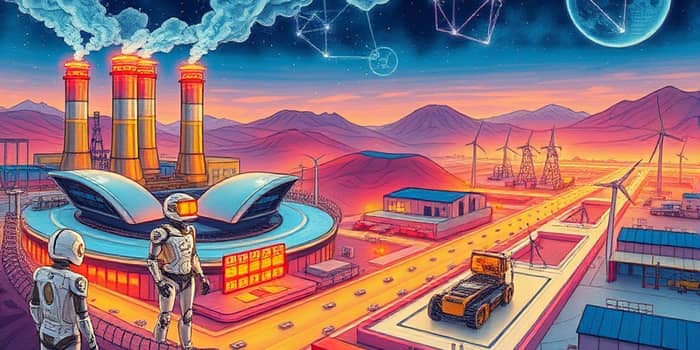
In an age defined by rapid innovation, a new wave of technologies is transforming economies, industries, and societies. From intelligent machines to quantum breakthroughs, these advances are no longer incremental—they are structural growth drivers for the global economy.
At the heart of today’s transformation is the idea that technology has evolved into a system-wide infrastructure reshaping the real economy. No longer confined to labs or isolated industries, AI, robotics, IoT, and big data now power everything from energy systems to healthcare diagnostics.
Research shows that by 2030, we will see AI assistants embedded in daily life, autonomous vehicles on our roads, and factories driven by digital twins. Yet, this adoption will be uneven across sectors and geographies—creating both winners and laggards.
Imagine a world where climate models run in real time enabling farmers to optimize water use. Where remote surgeries are guided by AI in underdeveloped regions. This future is within reach—and leaders can seize it by aligning strategy and resources around these foundational principles.
Building on generative AI, agentic AI introduces machines capable of autonomous decision-making and execution. These agentic AI agents with autonomy operate 24/7, managing complex workflows from customer service to supply chain optimization.
For example, an agentic AI system can autonomously manage retail inventory, negotiate supply orders with vendors, forecast demand patterns, and adjust pricing strategies without direct human oversight. At scale, this creates a new economic layer that runs in parallel to human-driven processes.
To navigate this shift, organizations should establish cross-functional teams that blend data science, ethics, and domain expertise. Practical pilots—such as customer support agents or autonomous logistics planning—can reveal the true potential and surface necessary guardrails.
To understand how these technologies manifest in the market, we can separate deep structural changes from their industry-specific applications. Foundational trends reshape the technology stack itself, while functional trends deliver targeted solutions.
People-centric productivity is empowering workers through collaborative copilots that reduce administrative burdens and free up creative problem solving. Meanwhile, digital trust solutions ensure transparency in AI decision-making—an essential foundation for scaling transformative applications.
As AI permeates every layer of software, traditional cloud models face limitations. Data sovereignty, low-latency requirements, and the need for proprietary model fine-tuning have given rise to a diversified ecosystem of public, private, and hybrid clouds.
Enter cloud as the operational backbone for AI. These advanced cloud architectures support specialized hardware, scalable storage, and secure networks that cater to mission-critical AI workloads. Businesses should audit existing deployments, identify workloads with stringent latency or sensitivity needs, and adopt edge or private cloud solutions accordingly.
By partnering with leading cloud providers that offer AI-optimized infrastructure, organizations can accelerate innovation while maintaining control over sensitive data and compliance requirements.
Perhaps the most compelling theme across all research is convergence. It is not a single breakthrough but the intersection of complementary technologies—AI, robotics, electrification, and cybersecurity—that unlocks the greatest potential.
Consider a software-defined factory that harnesses AI-driven analytics, digital twins for simulation, automated robotics for assembly, and secure networks for data integrity. Each component magnifies the others, creating a resilient, adaptive system that responds to demand shifts and supply chain disruptions in real time.
Cities of the future could integrate digitized traffic management, autonomous public transport, and renewable energy microgrids—all orchestrated by AI insights to ensure safety, efficiency, and sustainability. This vision becomes achievable when stakeholders align across public and private sectors.
Organizations and investors looking to harness these disruptive forces should consider the following practical steps:
By aligning strategic investments with convergence as the main investment thesis, businesses can not only survive the next decade of rapid change but also lead in creating new markets and societal value.
The future belongs to those who view these emerging technologies not as isolated tools, but as an integrated ecosystem—a powerful digital foundation on which to build sustainable growth and global impact.
References