Search
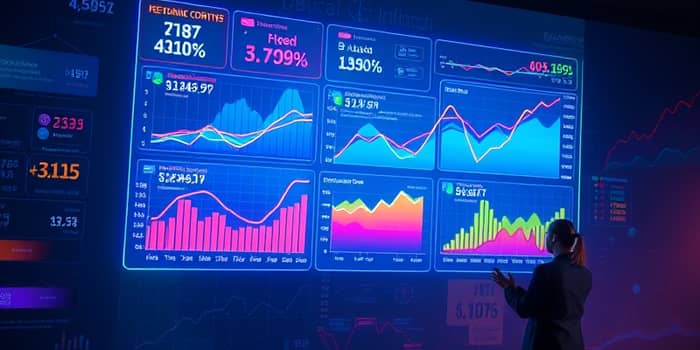
Every investor dreams of a crystal ball to reveal what lies ahead. In reality, uncertainty is the only certainty. But modern technology offers a powerful alternative: predictive portfolio simulators. These platforms help you explore a spectrum of plausible futures before you commit your capital.
Predictive simulators are software platforms that model future portfolio outcomes. They combine advanced mathematics, vast datasets, and computational power to quantify risk and reward under multiple scenarios. Instead of one forecast, they generate thousands of possible trajectories, each reflecting a different set of market conditions.
Key ingredients of these tools include historical data, stochastic processes, scenario libraries, and AI-driven models. Together they enable you to visualize volatility, stress-test your allocation, and quantify uncertainty and show realistic ranges for returns.
On the consumer front, platforms like PortfolioPilot bring institutional-grade simulation into your home. Marketed as an AI financial advisor, it aggregates your brokerage accounts, retirement plans, real estate, crypto, and even student loans into a single view. You see your net worth levers in one place and receive automated alerts when risk thresholds are breached.
PortfolioPilot’s simulation feature lets you replay the Dot-com bubble, the Global Financial Crisis, and the Covid-19 shock against your personalized allocation. By analyzing tens of thousands of historical data streams, the platform generates probability distributions for your portfolio’s performance under each stress. You don’t get a single prediction―you see probability-based risk and return ranges and clear “what-if” comparisons.
Its hybrid-AI recommendation engine merges quantitative models with a conversational interface, so you can upload statements, ask natural language questions, and receive suggestions to hedge risks or capture emerging opportunities. Its intuitive portfolio score blends risk-adjusted returns, downside protection, and alignment with your chosen risk tolerance.
For data-savvy investors and DIY enthusiasts, open-source tools offer a hands-on path. With Python libraries such as NumPy, pandas, and yfinance, you can craft a Monte Carlo simulator in a few dozen lines of code. The process demystifies how random sampling and statistical estimation converge on insights.
In a typical Python-based workflow, you pull historical price data, compute daily returns, and derive a covariance matrix. Then you generate multivariate normal draws to simulate thousands of potential portfolio trajectories. Over time, the outcomes form a distribution that highlights the chance of various wealth levels or drawdown events.
This DIY approach teaches you the mechanics behind probabilistic financial forecasting and builds confidence in interpreting risk metrics like Value at Risk (VaR), worst-case drawdowns, and terminal wealth probabilities.
Beyond retail and DIY, simulation tools serve as training grounds and decision engines for professionals. Finsimco, designed for MBA and MSc students, replicates a live fund management competition. Participants apply mean-variance optimization, monitor real-time market feeds, and vie to produce the highest Sharpe Ratio in a compressed, high-pressure environment. This hands-on lab fosters strategic thinking and disciplined risk management without risking actual capital.
In the private equity arena, CEPRES Predictive Intelligence focuses on cash flow timing, commitment pacing, and stress-testing guidelines. Its drag-and-drop interface lets limited partners model complex portfolios, set minimum and maximum allocation rules, and visualize long-term cash flow projections. Hundreds of backtests under pandemic and volatility stress scenarios ensure the engine recognizes extreme net asset value movements and overvaluation risks.
Predictive simulators don’t promise certainty; they offer clarity. By mapping out a landscape of possible outcomes, they empower you to make forward-looking decisions with confidence. You learn where your vulnerabilities lie and how to adjust your sails when economic winds shift.
Whether you adopt a turnkey platform, code your own Monte Carlo engine, or leverage professional-grade dashboards, these tools transform fear of the unknown into actionable insight. They show you not just a single path, but a rich tapestry of possibilities, each with quantified risks and rewards.
As you integrate predictive simulations into your process, you become less reactive and more strategic. You set thresholds, monitor live deviations, and rehearse responses to adverse events. In doing so, you cultivate resilience and seize opportunities that others might overlook.
In the end, seeing your future is not about finding a guaranteed outcome. It’s about understanding the range of what can happen, preparing for surprises, and steering toward your goals with informed conviction. Harness these simulators, and let your investment journey be guided by vision as much as by hope.
References