Search
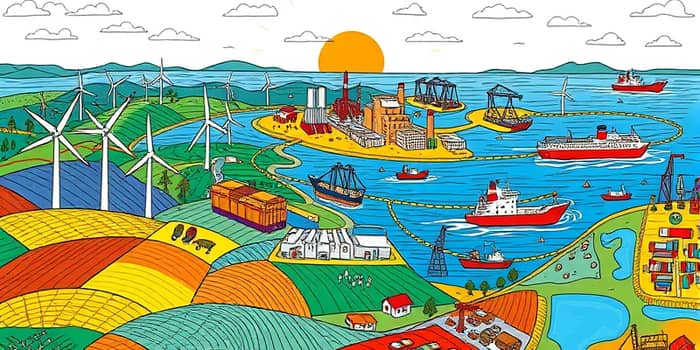
Economic systems are like vast oceans of interdependence, where a drop in one region sends waves across the entire surface. Understanding these interconnected networks influence productivity is crucial for businesses, policymakers, and communities. This article reveals how decisions in one sector cascade into broad societal and global impacts, offering practical guidance to harness these forces for sustainable growth.
Ripple effects describe how a single change in one economic sector propagates through supply chains, employment, innovation, and regional economies. These phenomena can generate both opportunities and vulnerabilities, depending on the network’s structure and resilience. By mapping these pathways, stakeholders gain insight into potential gains and pitfalls.
At their core, ripple effects demonstrate how actions in one industry influence multiple others. A firm’s decision to adopt new technology, for instance, leads to training programs, workflow adjustments, and financial reallocations. These shifts extend to suppliers, customers, and even competitors.
Within firms, a single strategic choice can trigger an entire cascade of operational changes. Quality and financial departments may need to realign budgets, human resources develop specialized training, and external partners adjust their own processes. This interplay shapes corporate culture, employee morale, and ultimately, the bottom line.
By conducting regular qualitative analysis and stakeholder consultations, organizations can anticipate unintended consequences and build in adaptive measures. This continuous reevaluation prevents costly disruptions and promotes agility in a rapidly changing landscape.
Regions characterized by “tight” industry networks—where rare or specialized industries co-locate—often enjoy high productivity and earnings. However, this specialization can backfire when shocks hit a key sector, amplifying fragility across the entire network.
This table highlights concrete examples across sectors, demonstrating how interconnected decisions create widespread outcomes. Regional planners and industry leaders can use such mappings to balance specialization with diversification strategies.
Beyond productivity and fragility, some enterprises generate regenerative ripple effects, creating virtuous loops across economic, social, and natural capitals. For instance, businesses in renewable energy, circular manufacturing, and sustainable agriculture restore ecosystems, improve community wellbeing, and unlock new financing.
At the global scale, comparative advantage, technology transfer, and capital flows have tripled since the mid-1990s, delivering welfare gains, risk-sharing, and innovation. Coordinated policies among leading economies could expand global GDP by 3%, but fragmentation risks threaten a 7% contraction without careful design.
To navigate ripple effects successfully, stakeholders must weigh potential upsides against drawbacks. Positive outcomes often include efficiency gains, job creation, and welfare improvements. Negative consequences may manifest as job displacement, local downturns, and amplified shocks in tightly woven networks.
By embracing proactive measurement methods like Ripple Effects Mapping (REM), decision makers can capture qualitative impacts across complex systems, ensuring interventions remain intentional and adaptive.
Practical strategies for leveraging ripple effects include:
Organizations and policymakers should foster a culture of continuous learning and strategic foresight to anticipate and guide cascading outcomes. This involves integrating data analytics, stakeholder feedback, and scenario planning to remain agile.
The economies of tomorrow will reward those who understand and shape ripple effects with purpose. By mapping interdependencies across sectors, embracing regenerative loops, and crafting inclusive policies, we can steer waves of change toward prosperity and resilience.
Ultimately, the ripple effect is not an unpredictable force to fear, but a powerful tool to wield. With intentional design and collaborative spirit, every action can spark positive transformations that resonate far beyond its origin.
References