Search
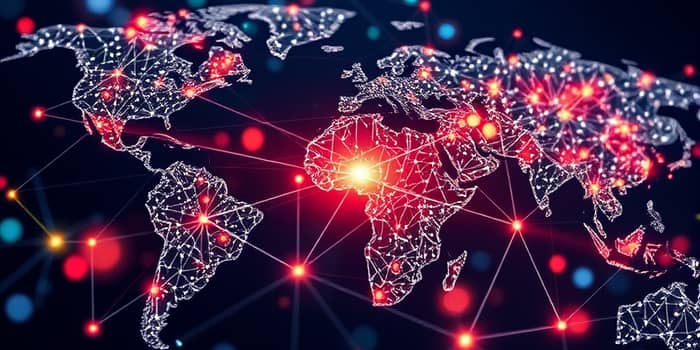
Financial markets are like an intricate tapestry of connections, where a single tug can reverberate across the entire fabric. Understanding the transmission and amplification of shocks is essential for investors, policymakers, and businesses alike.
In this article, we explore how localized disruptions cascade through systems, examine historical precedents, and offer strategies to build resilience in an increasingly interconnected world.
At its core, financial contagion describes a significant increase in cross-market linkages following a shock to one institution, asset class, or region. Unlike normal co-movement driven by shared fundamentals, contagion involves correlations that spike disproportionately during crises.
Experts define it as the process by which losses, liquidity squeezes, and confidence shocks ripple across boundaries, creating systemic distress. Recognizing this distinction helps differentiate contagion from mere interdependence or spillovers tied to common global factors.
Shocks travel through multiple mechanisms, each capable of magnifying initial disturbances:
Additional channels include information-driven herd behavior, algorithmic trading triggers, and shared infrastructures like clearing systems or currency unions. Each pathway can interact, creating a network effect that accelerates shock propagation.
Markets naturally co-move due to globalization and shared economic cycles—this is interdependence. Contagion goes further when correlations jump beyond what fundamentals justify. During the 1997 Asian crisis, competitive devaluations and investor panic drove valuations in non-exposed markets down sharply, illustrating how sentiment and self-fulfilling expectations can push systems toward a “bad equilibrium.”
Distinguishing between normal linkages and true contagion is vital for crafting targeted policy responses and allocating capital prudently.
The 1929 crash spread from New York to London and Berlin over weeks, while today’s electronic markets can transmit turmoil in minutes. Notable contagion episodes include:
Each event reveals how evolving channels—be it derivatives, algorithmic trading, or digital assets—reshape the speed and scope of contagion.
Beyond balance sheets and trade matrices, human psychology and organizational structures play a central role. Information asymmetries lead investors to sell assets by association rather than fundamentals. Herd behavior, fueled by loss aversion and risk aversion, can trigger indiscriminate fire sales.
Institutions sharing the same currency or settlement systems face an added layer of vulnerability. The eurozone crisis demonstrated how problems in one member state cast doubt on the stability of the entire union, as banks and sovereign borrowers were seen as inseparable.
While contagion cannot be eliminated, organizations and regulators can adopt practical measures to cushion the blow:
Additional steps include transparent disclosure of exposures, robust capital requirements, and coordinated central bank swap lines to ensure cross-border liquidity support during turmoil.
For portfolio managers and corporate treasurers, practical actions can strengthen defenses against contagion:
Maintaining open communication with stakeholders and coordination with regulators also fosters confidence when markets waver.
The contagion effect underscores the fragility and interconnectedness of modern financial systems. While globalization and technology have accelerated shock transmission, they also offer tools for real-time monitoring and rapid response.
By understanding the main channels of transmission, learning from historical precedents, and adopting robust risk management practices, institutions can navigate turbulent waters more confidently. In a world where shocks can spread like wildfire, resilience is the best defense against systemic turmoil.
References