Search
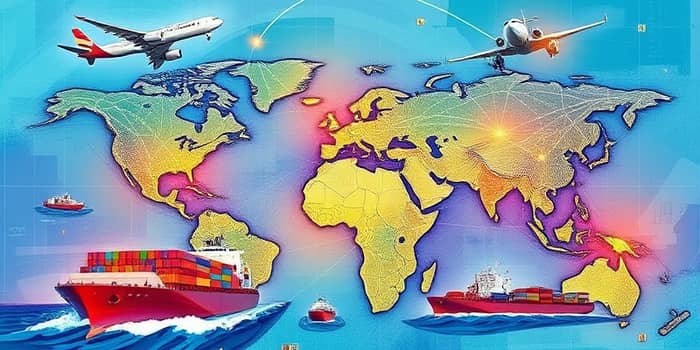
As global commerce continues to evolve, businesses, policymakers, and communities must navigate a labyrinth of opportunities and challenges. The year 2025 witnessed global trade soar to a record $35 trillion in total value, a 7% increase from the prior year. Despite mounting geopolitical tensions and supply chain disruptions, momentum carried into 2026, albeit at a tempered pace. This article explores the forces reshaping trade, offers actionable insights, and illuminates a path forward grounded in resilience and innovation.
In 2025, export volumes were driven by major economies bolstering reserves of critical technologies, particularly AI hardware, even as emerging markets like India and Brazil expanded their footprint. The IMF and UNCTAD project 2026 growth between 2.6% and 3.3%, with developing nations outside China leading at 4.2%. Meanwhile, the United States and China are set to experience slower yet still positive increases of 1.5% and 4.6% respectively.
These trends reflect a global appetite for connectivity, even as trade wars and protectionist measures cast long shadows. The extended stockpiling of semiconductors, waivers for AI equipment, and strategic tariffs paint a complex picture: governments are both facilitating and constraining flows in service of national security and industrial policy.
One of the most profound shifts is the deliberate pivot toward geopolitically aligned partners. Tariff regimes have surged, with advanced economies imposing new levies on manufacturing imports while granting exemptions for sectors deemed critical. The result is longer supply chains skewed toward friendly nations, a trend often termed “friendshoring.”
For businesses, this reorientation demands a recalibration of sourcing strategies. Companies are now evaluating partners based on political stability and alliance structures, not solely cost. Embracing a multitude of dynamic trade trends allows them to hedge risks and seize emerging opportunities across regions.
The pandemic underscored vulnerabilities inherent in lean, cost-focused supply chains. In response, firms shifted to a resilience-first mindset. Investments in digital tools, advanced analytics, and collaborative platforms have become paramount. Real-time visibility—once a luxury—is now a necessity.
Across industries, the mantra has shifted from “just-in-time” to “just-in-case.” Companies are forging deeper ties with tier-one and tier-two suppliers, sharing data and aligning on forecasting to mitigate disruptions. A new wave of regional hubs—Mexico and Vietnam for North America, Eastern Europe for the EU, and Southeast Asia for East Asia—has emerged in response to rising labor costs and political uncertainty in China.
Global trade is far from monolithic; each sector exhibits unique dynamics. Electronics exports from China to the US declined, while ASEAN and India captured gains in smartphone and laptop manufacturing. Pharmaceutical and medical equipment shipments experienced robust growth, fueled by US frontloading orders from Europe. Automotive and textile trade lagged, with ASEAN output offsetting China’s share loss. The semiconductor arms race intensified, prompting US waivers and hefty subsidies for domestic chip fabrication.
These developments underscore the tension between cost optimization and strategic autonomy, as governments worldwide incentivize local production of critical goods, reshaping traditional trade patterns and raising the stakes for global competitors.
The effects of these transformations manifest differently across regions. In the US, stockpiling and AI investments propelled import growth, even as tariffs channeled trade away from China toward Mexico, Canada, and the EU. China, in turn, deepened its role as a supplier of intermediates to emerging economies, reinforcing value chains within Asia.
India’s diversified gains in electronics and machinery reflect deliberate policy efforts to attract foreign investment, while Europe’s modest demand for raw materials has been met by increased exports of high-value medical and chemical products. Africa and Latin America are deepening South-South ties by trading commodities, infrastructure, and consumer goods, creating a more balanced global map of trade flows.
Looking toward 2026, fragmentation and volatility will persist. Trade policies continue to fragment global supply chains, and cyber and geopolitical risks loom large. However, this period also offers a chance to build more resilient, equitable, and sustainable systems.
Policymakers and leaders can prioritize a framework that balances national interests with global cooperation. By investing in joint research, enhancing transparency, and supporting diversification, stakeholders can reduce exposure to shocks while fostering inclusive growth.
As we navigate these shifting sands, a collaborative mindset—prioritizing mutual benefit over unilateral gain—will be the guiding light. By embracing innovation, cultivating relationships, and adapting swiftly, businesses and governments alike can transform uncertainty into a powerful catalyst for sustainable growth and shared prosperity.
References