Search
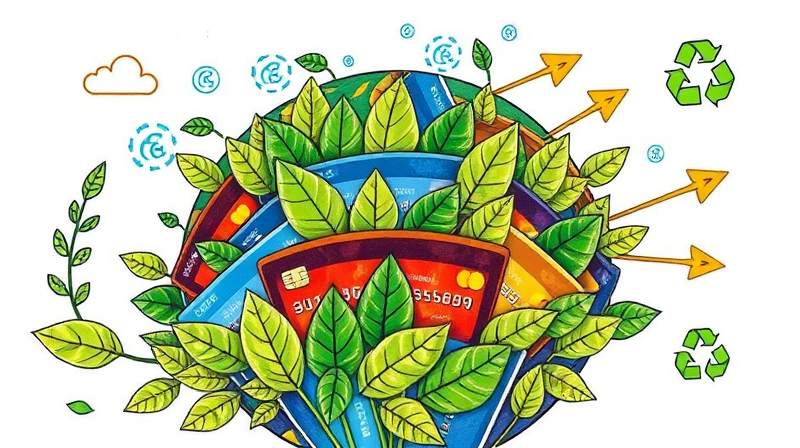
Credit cards power global commerce, but they also generate plastic waste and CO₂ emissions. By aligning card production and usage with circular economy principles, financial institutions and consumers can drive a more sustainable future.
The circular economy seeks to design out waste and pollution, keep products and materials in use, and regenerate natural systems effectively. For payment cards, this means reevaluating every stage—from material sourcing to end-of-life disposal.
Adopting these principles requires collaboration between issuers, manufacturers, recyclers, and cardholders. When they act in concert, every expired piece of plastic can become the seed of a new financial tool—rather than waste.
In 2021, over 17.2 billion credit and debit cards circulated globally, primarily made from PVC—a material that is difficult to recycle and generates toxic emissions if incinerated.
The production of these cards alone produced 293,525 tonnes of CO₂e, equivalent to driving a diesel car around the Earth 43,000 times. Meanwhile, the emissions from 787 billion card transactions totaled 416,742 tCO₂e. If replaced by lower-impact ACH or account-to-account payments, emissions could drop by 75%, saving 312,520 tCO₂e—akin to eliminating 90,000 round-trip economy flights between New York and San Francisco.
Despite this scale of impact, most expired cards end up in landfills or waste-to-energy plants because they contain embedded chips, magnetic stripes, and metal elements. Their complexity necessitates specialized recycling processes, which many institutions have yet to implement.
Leading banks and card manufacturers are pioneering reducing virgin plastic use through recycled, bio-based, and upcycled materials. These innovations demonstrate how industry leaders can embed sustainability into everyday financial tools.
Bio-based cards, like those from Amalgamated Bank, replace up to 80% of fossil-based plastics, earning the “fossil-free” label. However, experts caution that biodegradability often requires industrial composting conditions, and microplastics may still form.
Recycling expired cards demands safe data destruction and material separation. Programs such as G+D’s Convego Beyond and the Mastercard–HSBC–TerraCycle pilot in the UK show how banks can close the loop.
By turning recovered plastics into furniture or community items, banks visibly demonstrate circular principles to stakeholders and boost consumer trust in their sustainability commitments.
Every stakeholder has a role to play. Banks can:
Consumers, meanwhile, can:
Adopting lower-impact payment rails for routine transactions—like everyday bills—can reduce per-transaction emissions by up to four times compared to traditional card payments.
A circular approach to credit and debit cards is not merely about swapping materials—it demands systemic change. Financial institutions must partner with manufacturers, recyclers, and regulators to redesign card lifecycles.
Innovation is emerging: banks report that 73% of cardholders value environmental consciousness. This consumer demand, combined with regulatory support and technological advances, can accelerate adoption of circular solutions.
As the global card pool continues to grow, the pressure to reduce waste and emissions intensifies. Yet, by embracing take-back schemes for expired cards and innovative materials, the finance industry can transform a once-linear model into a regenerative cycle.
The journey toward a circular economy for payment cards illustrates how everyday tools can become catalysts for sustainability. By redesigning materials, refining recycling processes, and empowering consumers to choose lower-impact payments, we can keep materials in use longer and drive real environmental benefits.
Now is the time for issuers, manufacturers, and cardholders to unite around a shared vision: a financial system where every swipe, tap, or digital transfer not only moves money but also supports the health of our planet.
References