Search
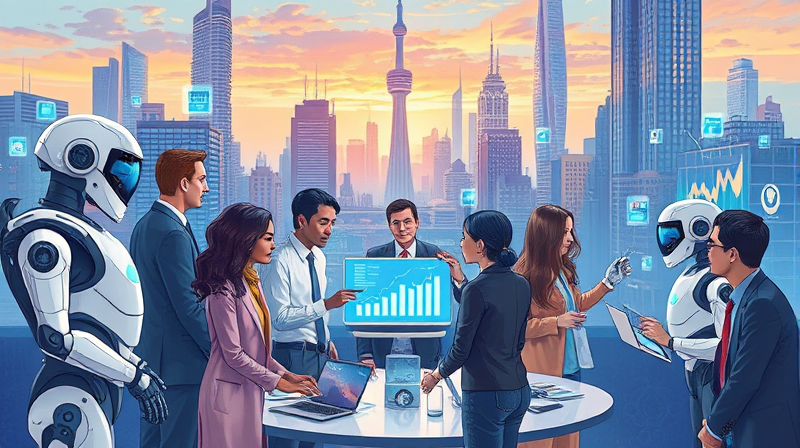
The landscape of employment is undergoing a seismic shift as digital innovation, demographic change, and shifting economic ties reshape how work is done, valued, and compensated. For investors, policymakers, and individuals alike, understanding this transformation is not just academic—it is essential to thriving in the decades to come.
From boardrooms to small startups, leaders are grappling with the implications of automation, artificial intelligence, and new labor market dynamics. By appreciating the interplay of these forces, we can craft policies, business strategies, and personal roadmaps that harness opportunity and mitigate risk.
At its core, the future of work reflects the broader evolution of global markets. Strategic investors recognize that labor costs, productivity gains, and sectoral valuations hinge on workforce dynamics. According to the World Economic Forum, key drivers such as geoeconomic fragmentation and economic uncertainty and rapid tech innovation are set to redefine competitive advantage by 2030.
These macro forces directly influence corporate cost structures and national productivity statistics. Aging societies in advanced economies contrast sharply with youthful labor surpluses in parts of the Global South, shaping decisions on offshoring, reskilling, and automation deployment.
As many as 40% of global jobs face AI-driven change and automation exposure, according to IMF estimates. Goldman Sachs projects that 300 million roles worldwide are potentially exposed to automation, with a base-case displacement of 6–7% of workers over ten years. For young entrants, early research indicates up to a 16% fall in employment among AI-exposed occupations.
However, the shift often targets tasks rather than entire roles. McKinsey forecasts that roughly 30% of current work activities in the U.S. could be automated by 2030, with half of all activities potentially automated between 2030 and 2060. The outcome will be a labor market where humans and machines complement rather than fully replace each other.
Transitional unemployment may rise modestly—around one percentage point over the medium term—unless redeployment and upskilling programs keep pace. Without swift action, the risk of structural unemployment and skills mismatch could deepen economic and social divides.
Counterbalancing displacement, automation and AI innovation will spur entirely new categories of work. The World Economic Forum identifies AI specialists, data scientists, and cybersecurity experts among the fastest-growing roles, while Goldman Sachs anticipates half a million net new jobs in power and data-center infrastructure in the United States alone.
Organizations will also demand complementary roles closely with AI, such as human-in-the-loop supervisors and AI trainers. In healthcare, for example, new specialized occupations in healthcare—from AI-assisted diagnostic analysts to personalized medicine coordinators—will emerge as technology becomes embedded in clinical workflows.
Moreover, many positions will evolve rather than vanish. Workday notes that roles will become hybrid roles blending technical skills and human-centric abilities, requiring employees to harness data, automation, and interpersonal expertise in equal measure.
Market demand for new capabilities is already driving wage premiums. IMF analysis shows that job postings requiring even one new skill pay roughly 3% more, while roles demanding four or more new skills command up to 15% higher wages in the UK and 8.5% in the US.
This skills premium and rising inequality underscores the need for robust upskilling strategies. Employers that invest in learning and development report higher innovation metrics, greater staff retention, and improved engagement.
By 2025, over half of all professions will require reskilling or upskilling to remain viable. Lifelong learning is no longer optional; workers must continuously update skills to adapt or risk obsolescence. Governments and corporations alike must create accessible training pathways and incentives to support this transition.
The future of work is not a zero-sum game—it is an evolving ecosystem where technology, talent, and policy intersect. By anticipating trends, fostering post-pandemic acceleration and workforce transformation, and prioritizing inclusive skill development, we can build markets that grow sustainably and equitably.
Individuals should embrace a mindset of lifelong learning, organizations must embed reskilling into their cultures, and policymakers need to balance safety nets with incentives for innovation. Together, we can shape a future where technological progress elevates human potential and ensures that prosperity is broadly shared.
References