Search
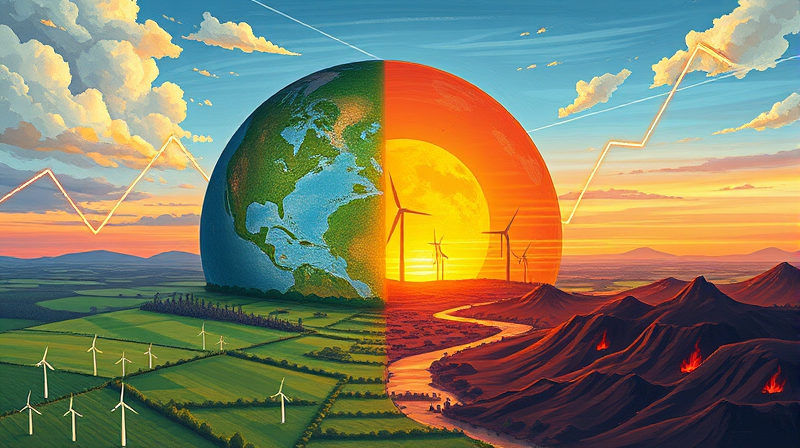
As climate change accelerates, its impact on the global economy is becoming impossible to ignore. Investors face a landscape shaped by both grave risks and transformative opportunities.
From physical damage to assets to shifts in policy and technology, understanding these dynamics is no longer optional—it is essential to securing long-term returns and contributing to a sustainable future.
Climate change brings more frequent and intense heat waves and other hazards that can erode asset values and disrupt markets. These shocks are already reframing risk assessments across industries.
Meanwhile, the transition to a low-carbon economy carries its own set of hazards. As governments tighten regulations and markets embrace clean technologies, traditional high-carbon assets risk being stranded or devalued.
Long-term economic growth is at stake. By mid-century, climate damage threatens to impose a systemic drag on global output and welfare. Key estimates illustrate the scale:
In the United States, the Congressional Budget Office projects that further warming could reduce real GDP by around 3% by 2100, with a 5% chance of a 17% loss in GDP—equivalent to nearly $4.7 trillion today. Distributional effects compound the challenge: lower-income and minority communities often bear the brunt of physical risks and have fewer resources to adapt.
For investors, these macro risks translate into shifts in interest rates, inflation, government spending and taxation—all core drivers of asset prices. Ignoring them risks mispricing entire markets and undermining portfolio resilience.
Households are already facing the financial fallout from climate hazards. A recent synthesis estimates that an average American born in 2024 will incur $500,000 in additional costs over a lifetime, with high-impact areas reaching $1 million.
Businesses face parallel challenges. Manufacturers grapple with higher cooling and safety costs, while logistics networks are disrupted by storms and floods. In agriculture, altered rainfall and heatwaves lower yields, driving food price inflation and squeezing farm incomes.
Financial markets are already pricing in climate risks, both physical and transitional. Coastal real estate values adjust to rising flood maps, insurers hike premiums or withdraw coverage, and utilities reevaluate asset lifespans in light of shifting regulations.
On the transition side, carbon pricing and emissions caps weigh heavily on fossil fuel producers, heavy industry, and traditional power utilities. Simultaneously, companies leading in clean energy and climate tech are attracting capital at ever-lower cost, reshaping valuation paradigms.
When risks are systemic, they influence sovereign credit ratings, bond yields and cost of capital across the board. Climate change is not just an idiosyncratic risk to be hedged—it is a pervasive force redefining market fundamentals.
Meeting global net-zero targets by 2050 demands a massive reallocation of capital. Studies estimate that low-carbon investments must rise to more than $5 trillion per year by 2030 to stay on track. This capital surge must flow into renewables, energy efficiency, climate tech, sustainable infrastructure and natural capital preservation.
Investors can seize this moment by integrating climate analysis into every stage of decision-making. Strategies include:
By doing so, investors not only safeguard returns against cascading climate risks but also drive the capital flows needed to decarbonize the global economy. The path ahead is complex, but decisive action today can protect portfolios and help build a more resilient, prosperous world.
References